Here are a couple recent projects I have worked on.
Dimension Theory of Posets
The Dushnik-Miller dimension of a poset
An important example is the boolean hypercube ![[n]](https://s0.wp.com/latex.php?latex=%5Bn%5D&bg=8DD2FC&fg=000&s=0&c=20201002)
A notable open problem is the case of two consecutive layers of the hypercube. In particular, there is an exponential gap in the best known bounds for
In my paper from Duluth 2021, I introduced multiset analogs of the above posets, as well as a weighted multiset generalization to use techniques from known work to make progress on the dimension of divisibility orders. An interesting open problem here is to understand how the choice of weights for the elements


![I\subseteq [0,n]](https://s0.wp.com/latex.php?latex=I%5Csubseteq+%5B0%2Cn%5D&bg=8DD2FC&fg=000&s=0&c=20201002)


Irreducibility
Given a class of combinatorial objects with some notion of addition, we can define irreducible objects as those which cannot be written as a sum of other objects. A simple example is the set of nonnegative integer valued nondecreasing functions on a poset. Then the irreducible objects correspond to antichains in the poset. For a nice poset like the boolean hypercube, we know how to count the number of antichains asymptotically.
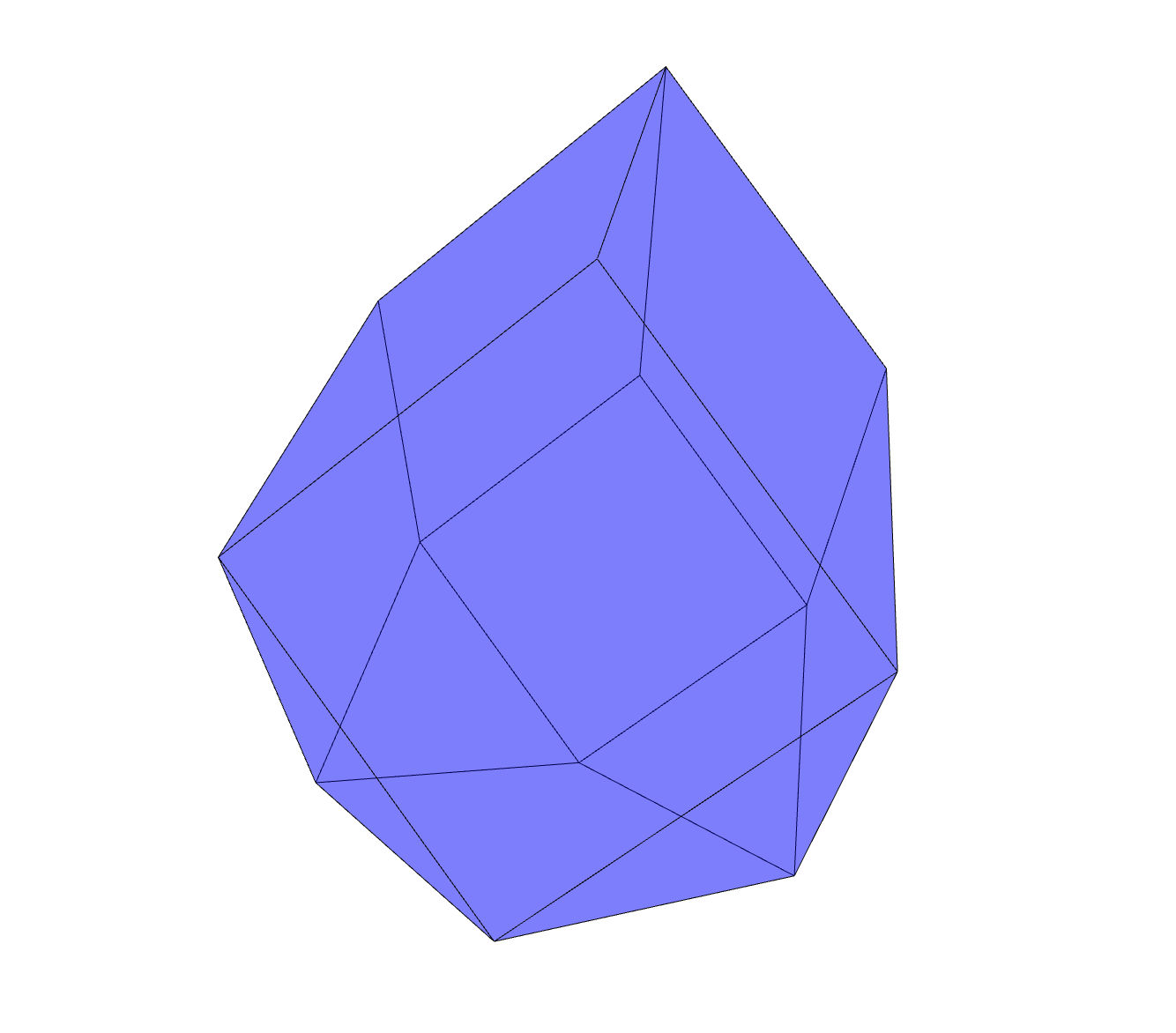
During SPUR 2022, I worked with Yuan Yao on understanding irreducible objects in more complicated classes of combinatorial objects. The main object we worked with was supermodular functions on the boolean hypercube. These functions are equivalent to generalized permutohedra, which were introduced by Postnikov. We have made progress on understanding the number of irreducible supermodular functions, but a precise asymptotic formula is not known.
A useful model problem for irreducibility is the following. Consider multisets whose elements are subsets of
![[N]](https://s0.wp.com/latex.php?latex=%5BN%5D&bg=8DD2FC&fg=000&s=0&c=20201002)
 Milan Haiman